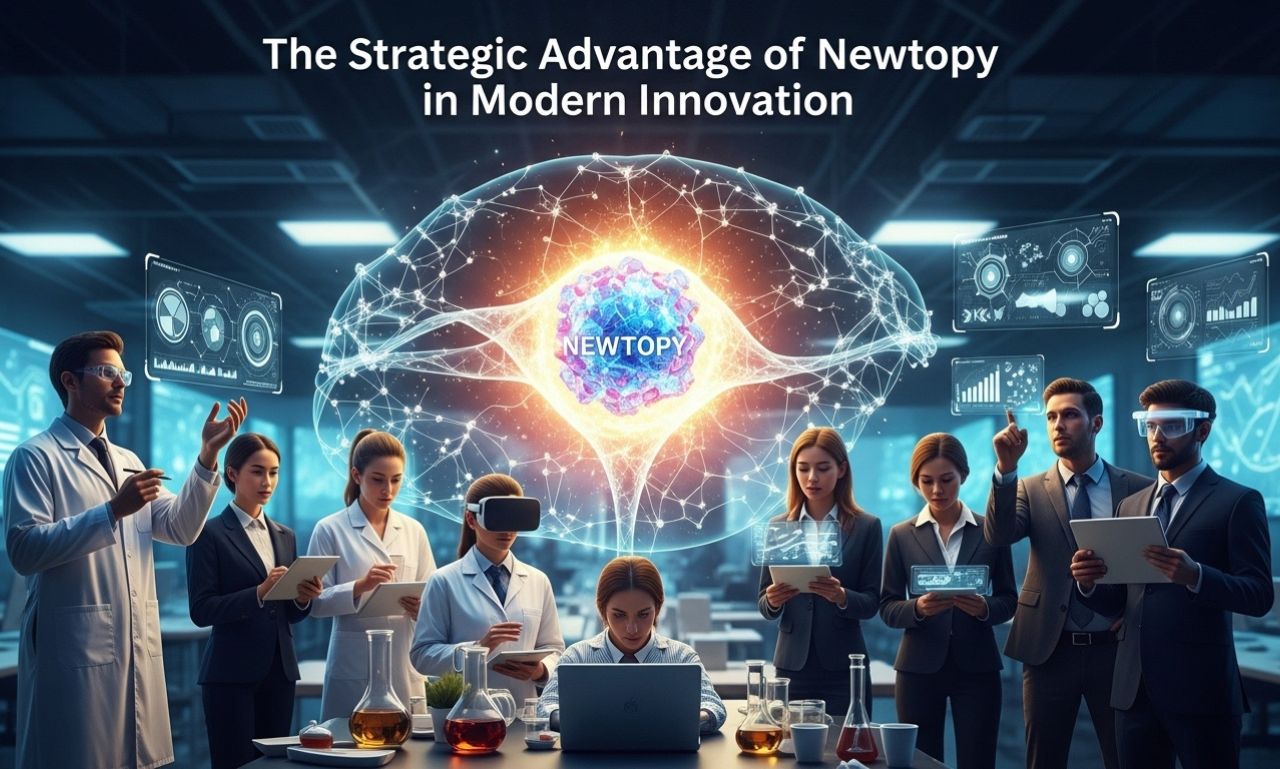
In an era defined by accelerated technological shifts and volatile consumer preferences, the ability to harness a concept known as newtopy has become the defining line between market leaders and obsolete enterprises. Unlike traditional novelty—which often implies superficial change or fleeting trends—newtopy represents a structured, strategic embrace of the “new” as a permanent operational state. For decision-makers navigating the complexities of 2026 and beyond, understanding this framework is no longer optional; it is the bedrock of sustainable relevance. This article explores how organizations and individuals can leverage the principles of newtopy to transform uncertainty into a repeatable competitive advantage, moving beyond reactive adjustments to proactive evolution.
What is Newtopy? Defining the Frontier of Perpetual Change
Before implementing any strategy, one must first dissect its core. The term newtopy derives from the fusion of “new” and the suffix “-topy” (from the Greek topos, meaning place or state). Therefore, newtopy refers to a “state of newness” or a deliberately constructed environment where innovation is not a project with a start and end date, but the very fabric of daily operations. It differs from concepts like “disruption” (which is often destructive and external) or “agile methodology” (which focuses on iterative speed). Instead, newtopy emphasizes the psychological and structural architecture that makes continuous novelty feel normal, manageable, and even predictable.
Consider the difference between a company that launches a new product annually (traditional novelty) and a company whose supply chains, team structures, and customer interfaces are designed to reconfigure monthly (newtopy). The latter has achieved a state where change is the baseline, not the exception.
The Three Pillars of a Successful Newtopy Ecosystem
To practically apply newtopy, one must build upon three interdependent pillars. Without these, attempts at perpetual novelty degrade into chaos or burnout.
1. Structural Fluidity
The first pillar demands that hierarchies and processes become temporary. In a newtopy-driven organization, teams form around problems rather than functions, and those teams dissolve once solutions are deployed. This requires modular systems—from IT infrastructure to legal contracts—that can be assembled and disassembled without friction. For example, a retail chain using newtopy might have store layouts that change every two weeks based on real-time foot traffic AI, not seasonal calendars.
2. Psychological Safety for Unlearning
Perhaps the most challenging aspect of newtopy is the human element. Most adults are conditioned to seek stability and mastery. Newtopy, however, rewards “unlearning”—the ability to discard yesterday’s best practice without ego. Leaders must create a culture where admitting obsolescence is celebrated, not penalized. This means performance reviews based on adaptability metrics (e.g., speed of adopting new tools) rather than just efficiency metrics.
3. Predictive Novelty Engines
The final pillar moves from reactive to proactive. A mature newtopy framework includes dedicated systems for scanning weak signals—emerging technologies, generational value shifts, or regulatory sandboxes—and turning those signals into small-scale experiments. These engines operate on a “fail fast, learn faster” protocol, where 70% of experiments are expected to yield negative results, yet those results are treated as valuable data for the next iteration of newness.
Why Newtopy Outperforms Traditional Strategic Planning
Traditional strategic planning, with its five-year roadmaps and fixed KPIs, assumes a relatively stable environment. That assumption is now a liability. Newtopy offers three distinct performance advantages that static models cannot replicate.
First, anti-fragility. In a volatile market, rigid plans break; flexible plans bend. But newtopy-based systems grow stronger under stress. When a supply chain fails, a newtopy organization doesn’t just find a new supplier—it reconfigures its entire logistics model to be supplier-agnostic, turning the disruption into a structural upgrade.
Second, talent magnetism. High-performing employees increasingly seek environments that offer growth through variety. A workplace built on newtopy provides endless learning opportunities, reducing turnover and attracting polymaths who thrive on change. Surveys from 2025 indicate that 68% of Gen Z professionals would take a pay cut to work in a “permanently evolving” role, precisely the condition newtopy describes.
Third, customer lock-in through surprise. Predictable value is commoditizable. Newtopy allows brands to deliver positive, unexpected shifts in user experience before competitors can copy the last innovation. Think of a software platform that subtly changes its interface every week based on behavioral data, reducing cognitive friction so effectively that users cannot imagine returning to a static design.
Common Pitfalls When Implementing Newtopy
However, pursuing newtopy without discipline invites specific dangers. The most common is “novelty fatigue,” where employees and customers feel exhausted by constant change. To avoid this, newtopy requires a rhythm of “pulsed newness”—periods of rapid iteration followed by brief consolidation phases. Another pitfall is the “shiny object syndrome,” where an organization chases every trend. Strategic newtopy filters opportunities through a clear mission filter: Does this novelty serve our long-term purpose? If not, it is discarded, no matter how exciting.
How to Begin Your Newtopy Transformation Today
Transitioning to newtopy does not require a complete corporate overhaul overnight. Instead, follow a phased, low-risk adoption path.
The Newtopy Audit (Weeks 1-2)
Map every recurring process in your unit—weekly meetings, approval chains, onboarding protocols. For each, ask: If we redesigned this from scratch today, would it look the same? Any process that has not changed in six months is a candidate for immediate dissolution.
The 5% Rule (Weeks 3-4)
Dedicate 5% of team resources (time, budget, or headcount) to a “newtopy lab.” This lab has no fixed deliverables except to produce one small, novel output every two weeks. It could be a new customer touchpoint, a different internal communication tool, or a reversed workflow. The goal is to build the muscle of creation, not the artifact.
Retrospective Unlearning (Ongoing)
After each monthly cycle, hold a 30-minute “unlearning retrospective.” Each team member must state one belief, skill, or tool they used last month that they will deliberately abandon this month. Document these abandonments publicly to normalize the process.
The Future is a State, Not a Destination
The ultimate lesson of newtopy is that there is no final, optimized state. The organizations that will thrive in the coming decade are not those with the best current products, but those with the highest rate of safe, strategic evolution. By embedding newtopy into your culture—through structural fluidity, psychological safety, and predictive engines—you stop chasing the future and start building the capacity to generate it. The question is no longer “How do we respond to change?” but rather “How quickly can we design the next relevant version of ourselves?” That is the power of newtopy.