
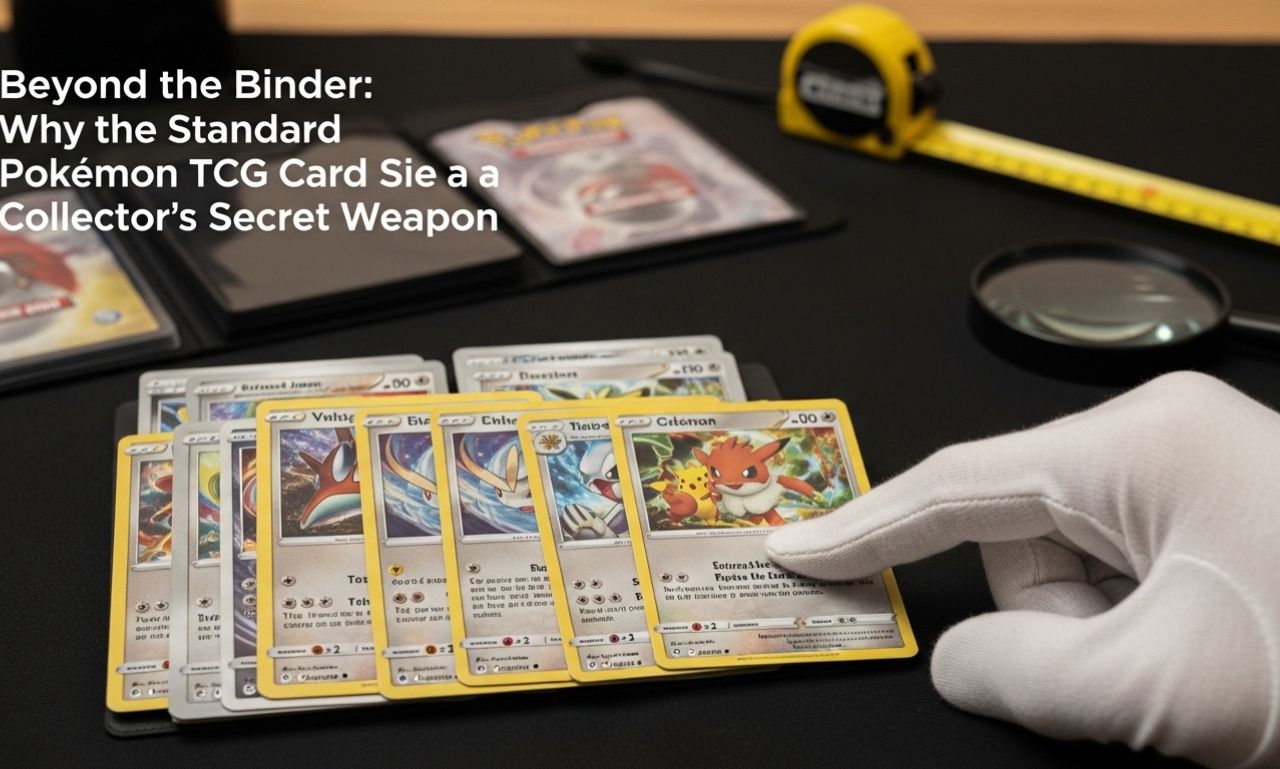
Every serious Pokemon TCG player remembers their first sleeve split. You shuffle a bit too aggressively, and suddenly your holographic Charizard is peeking out of a cracked plastic sheath. But have you ever stopped to ask why that sleeve failed? The answer lies not in the sleeve’s quality, but in the precise dimensions of the object it was trying to contain. The Pokemon TCG card size is more than a manufacturing spec; it is the silent gatekeeper of tournament legality, storage efficiency, and long-term preservation. While casual fans may see a simple rectangle, competitive collectors know that understanding the exact length, width, and thickness of a standard card can mean the difference between a mint-grade PSA 10 and a worthless, warped piece of cardboard. Let’s measure up.
The Anatomy of the Standard Pokemon TCG Card Size
Before we dive into storage solutions or grading nuances, we must establish the absolute baseline. The official Pokemon TCG card size has remained remarkably consistent since the Base Set launched in 1996. In the metric system, which is used by The Pokemon Company’s primary printers in Japan and the United States, each card measures exactly 63 millimeters in width and 88 millimeters in length. For collectors accustomed to imperial units, that translates to roughly 2.48 inches wide by 3.46 inches tall.
However, length and width are only half the story. The often-overlooked component is thickness. A single, standard Pokemon TCG card size in terms of caliper (thickness) is approximately 0.3 millimeters (or 0.012 inches). This minute measurement is crucial because it governs how many cards fit into a deck box, how easily they slide against each other, and how susceptible they are to humidity. Notably, this thickness differs from vintage Magic: The Gathering cards (which often run slightly thinner) and is drastically thinner than sports memorabilia cards. If you place four Pokemon cards together, their combined thickness equals roughly one standard credit card. Knowing this allows you to reject counterfeit cards immediately—fakes are often 0.1mm thicker or thinner due to cheap pulp paper.
How Deviations Destroy Tournament Legality
You might assume that a millimeter here or there doesn’t matter, but in sanctioned Play! Pokemon events, the Pokemon TCG card size is enforced through a practice called “the deck check.” Tournament judges use clear, acrylic template boxes. If a single card is too wide, too tall, or has been trimmed to remove edge wear, it will not slide smoothly into the template. Why does this rule exist? Because marked cards destroy competitive integrity.
Imagine a slightly wider card that bulges visibly in a sleeved deck. A dishonest player could cut corners (literally) to identify where their key supporter cards are located. Similarly, if the Pokemon TCG card size has been altered by humidity swelling—where edges expand to 63.5mm—the card becomes a “marked” card by definition. You will receive a game loss. Even factory miscuts, which some collectors fetishize as rare errors, are not legal for tournament play. The rulebook is absolute: every card in your sixty-card deck must conform to the true, original dimensions. Thus, memorizing the official 63x88mm standard is your first defense against an accidental disqualification.
Sleeving, Binders, and the Margin of Error
The entire multi-million dollar accessory industry for trading cards exists because of the Pokemon TCG card size. However, not all sleeves are created equal. You have likely seen “standard” or “pro-fit” sleeves advertised as fitting Pokemon cards. Technically, they do. But a perfect fit inner sleeve measures exactly 64mm x 89mm—just one millimeter larger than the card itself. This is by design; a sleeve that exactly matches the Pokemon TCG card size would cause friction, making it impossible to insert the card without bending the corners.
Here is where collectors make their biggest mistake. They assume that “any sleeve that fits is safe.” That is false. The critical variable is the top margin. Because the official thickness is 0.3mm, you need a sleeve that accommodates the stack height. When double-sleeving (placing the card in a perfect-fit sleeve upside down, then into a standard outer sleeve), the combined thickness doubles to 0.6mm plus air. If the outer sleeve is designed for sports cards (which are 0.5mm thicker), your Pokemon TCG card size will rattle around inside the sleeve. This rattling leads to micro-abrasions on the holographic foil over time. The correct sleeve should have an internal width of 63.5mm at most, gripping the card just enough to prevent movement but not enough to warp it.
Grading Standards and the Non-Negotiable Trim
If you ever plan to submit a rare card to PSA, Beckett, or CGC for grading, the Pokemon TCG card size becomes the most dangerous aspect of your submission. Graders do not use measuring tapes; they use laser-micrometer digital calipers accurate to 0.01mm. A card that measures 87.9mm in length (0.1mm short) will receive a “N5—Evidence of Trimming” designation and be returned ungraded, or given a grade of “Authentic” with no numerical value, destroying its market price.
Why is this so strict? Because shaving 0.2mm off the bottom edge is the oldest trick in the book to remove whitening or frayed corners. Even if you bought the card from a reputable seller, they might have accidentally purchased a trimmed card themselves. Consequently, serious collectors keep a millimeter ruler in their kit. When you hold a ruler against a true Pokemon TCG card size, the borders should be perfectly symmetrical. If the left border is 5mm wide and the right border is 4.8mm wide, but the card still measures 63mm total width, that means the image was printed off-center—but it is still legal. If the total width is 62.8mm, however, you have a trimmed or factory-error card that will never grade well.
Storage Solutions: Boxes, Bricks, and Bends
Finally, let us apply the Pokemon TCG card size to your home storage. A standard Elite Trainer Box (ETB) is designed to hold exactly 450 unsleeved cards. That number comes from a simple calculation: internal height (135mm) divided by card thickness (0.3mm). If you mix in toploaders or one-touch magnetic cases that are 3mm thick, your storage efficiency plummets. However, a more insidious problem is the “card bend.” Because the Pokemon TCG card size is relatively thin for its width, it is structurally vulnerable to humidity. In a 70% humidity environment, a Pokemon card will curl into a convex tube shape along its length. This is not a defect; it is physics. The cardboard backing expands faster than the foil layer.
To combat this, you must store cards in a silica-gel environment and never pack a deck box to 100% capacity. Leave a 2mm air gap at the top of the box. Why? Because if the box lid presses down on the cards with force, the 0.3mm thickness of each card compresses unevenly. Over five years, the cards at the bottom of the stack will become permanently 0.05mm thinner than the cards at the top. That micro-thinning will be detectable by a grader’s calipers. In essence, respecting the Pokemon TCG card size means respecting its fragility.
Conclusion
The trading card world loves to obsess over pull rates, artwork, and PSA populations. But those are secondary concerns. The primary physical reality of your collection is the Pokemon TCG card size—63mm wide, 88mm tall, and 0.3mm thick. Whether you are building a championship deck, filling a binder, or mailing a card to a buyer, these three numbers govern every interaction. A sleeve that ignores them will damage your edges. A storage box that ignores them will warp your foil. A tournament judge who tests them will disqualify you. So, take a moment today to measure one of your own cards. If it matches, you are safe. If it does not, you have just identified a problem that no rare stamp or holographic pattern can fix. Measure twice, shuffle once, and treat every fraction of a millimeter as the treasure it truly is.